The Lamb That Was Slain – A Passover/Easter Reflection

Posted by Dan Martin | Posted in atonement, Kingdom of God, Salvation | Posted on 30-03-2013

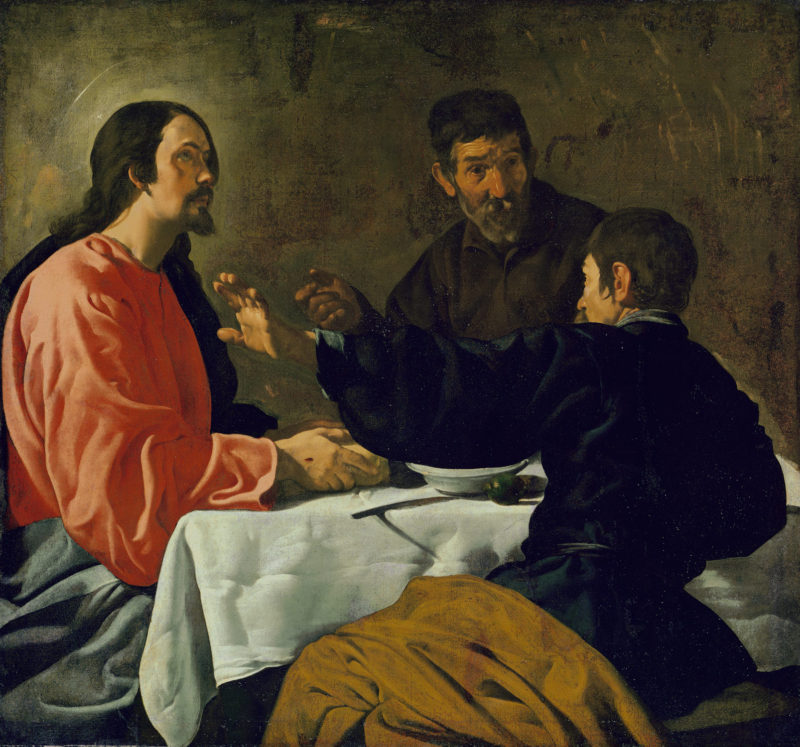
dali-last-supperThis Holy Saturday, between Good Friday and Easter, I was reflecting on the idea of Jesus as the slain Passover lamb.  The association is certainly Biblical, not only in the obvious context of Jesus’ death taking place on Passover, but also in the testimony of the Apostle Paul in 1:Cor. 5:7.  Paul doesn’t go into detail what he means about Jesus being the Passover lamb, but if we look carefully I think there are some helpful hints to be gleaned … hints that suggest Jesus’ shed blood means a great deal besides forgiveness of sins.

The Passover sacrifice is, of course, introduced in Exodus 12.  In this account, God instructs Moses to tell the people of Israel to slaughter a lamb and do two specific things with it:  mark their doorposts with its blood, and eat the flesh for dinner.  In stark contrast to the usual Christian narrative of sacrifices being for sin, I find it notable that the concept of sin does not appear in the entire tale from Exodus 11-13.  Both actions–the blood and the flesh–have a very specific purpose, and  neither is related to sin at all.

First, the Israelites were to mark their door frames with the lamb’s blood “as a sign.”  Those whose houses were so marked would not suffer the death of their firstborn, as happened to the rest of the households of Egypt.  It’s important to recognize that God didn’t “need” the label; some (though not all) previous plagues specifically spared the Israelites in Exodus 8:22 (flies), Exodus 9:24 (livestock died), Exodus 9:26 (hail), and Exodus 10:23 (darkness).  So the sign of the blood clearly was intended for the Israelites themselves, not so much for God and the angel of death.  Nevertheless, the sign was clearly one of identification.  The blood on the door marked a household not only as of the people of God, but people who had deliberately obeyed God’s command.  It was not the shedding of that blood–the sacrifice itself–that spared the Israelites from the death plague, but rather the application of that blood according to God’s instructions.  Might this be consistent with a God who prefers obedience to sacrifice (1 Sam. 15:22, Hosea 6:6)?

Second, the Israelites were to eat the roast flesh of the lamb.  No symbolism is given for this in the Exodus text, and in fact the only instructions are that it should be roasted not boiled, that it be eaten in haste and with unleavened bread, and that any leftovers be burned.  Without trying to extrapolate too much, I honestly wonder if this may not have been a highly pragmatic command for the simple reason that the people were about to travel on foot out into the desert, and they simply needed a good protein-and-carbohydrate meal to fortify them for the journey.  God’s commands can get downright practical at times.

We Christians pay too little attention to the Passover links to Jesus, I think.  Passover is the time when God called his people out of a foreign place, saving them from slavery, and in a very real way making them into “his people” in a way they had not previously been.  On the eve of their salvation, on the threshold of a new life as a newly-created  nation, God’s people were labeled by blood and strengthened by flesh of a sacrificed lamb.  Paul says something quite similar in Ephesians 2:13-14, where even we Gentiles have been “brought near by the blood of Christ,” and separate peoples have been made into one “in his flesh.”  Jesus told his disciples to eat of his flesh and drink of his blood at the Passover meal.  Just as God initiated a feast of remembrance on the eve of delivering the people of Israel, Jesus instituted a new meal of remembrance as he set in motion the new kingdom of his Body.  The body of Christ as well as the blood; the bread as well as the cup, is given to humans to unite and seal us as the people of God.  In his broken body and shed blood, we are marked as different, set apart from the death that rages around us, and ushered into a new kingdom.

There is much more in the Bible about the blood of Christ, and I don’t suggest for a moment that the Passover narrative is the whole story.  Still, it is one we should remember.  This “day of remembrance,” this “festival to the LORD,” is to remind us of our deliverance, our calling, our unification as the people of God.  Let us not forget.

“Speaking of Jesus – The Art of Not-Evangelism” by Carl Medearis (book review)

Posted by Dan Martin | Posted in Apologetics, Challenging conventional doctrine, Creeds, Culture wars and Current events, evangelism, Salvation | Posted on 28-01-2013

This is a review, but mostly a recommendation, of Carl Medearis’ book Speaking of Jesus – The Art of Not-Evangelism.  I’ll get to the review in a minute, but I’ll start by saying up front:  seriously, this is a book you should buy and read.  If you’re a Christian who’s interested in evangelism, you should read it.  If you’re sick to death of Christians trying to evangelize you, you should read it too.  And if you think there’s something sort of cool about Jesus and can’t figure out why those Christians yammer on about Jesus but seem so not like him, you REALLY should read it!

This book is not new … Carl published it in 2011 and somehow I only learned about it a couple weeks ago.  But I’ve been in dialog with Carl over Facebook for a year or two, mostly around the topic that it’s possible to be unapologetically a fan of Jesus and still have Muslim friends, and even talk with those Muslim friends about Jesus.  He does this through the crazy notion that if you actually love people and treat them as friends instead of, say, part of the “enemy” or the opposing team, they often reciprocate.  He also has this weird idea that if Jesus really is as powerful and important as we say he is, maybe meeting Jesus is more important than thinking the right stuff about Jesus.  So Carl lays out the case for realizing that introducing people to the person, character, and way of Jesus is something entirely different from trying to “win” them to a religion.  As he says in the book:

I don’t want to redefine salvation.  I don’t want to redefine the gospel or even Christianity on the whole.  I suppose I want to undefine them.  I want to strip away the thousands of years of graffiti painted onto the gospel, turning it into a reasonable code of doctrines.  The gospel is not an idea.  It is not a belief.  It is not a favorite verse.  The gospel does not live in your church, it cannot be written down in a simple message, and it is not the sinner’s prayer.  The gospel is not a what.  It is not a howThe gospel is a Who.  The gospel is literally the good news of Jesus.  Jesus is the gospel.

(emphasis in original)

People who’ve read my blog for any time know that one of my recurring frustrations is when people are driven away from considering the claims of Jesus, not because of who Jesus is, but because of the jerks we Christians can be (see this post if you want a refresher).  Under the guise of the “offense of the gospel,” Christians can be a downright offensive bunch at times.  As Carl put it, “We often blame Jesus when our evangelistic efforts fail … I don’t think it’s Jesus they aren’t liking.  It might be you.”

This book is a great thought-provoker.  One more quote to whet your appetite:

Maybe you’ll read this and think that I’m trying to make salvation easier or make a way for all the gays and liberals and Muslims and Buddhists to get in without going through all the “proper channels.”

Maybe yes and maybe no.  I’m not trying to change what salvation is because salvation is not my responsibility.  God didn’t put Carl Medearis in charge of deciding who stays and who goes.  That’s Jesus’ job, and He can keep it.

My job, no–my joy comes from sharing the good news of Jesus with people.  I point to Him, and He does all the heavy thinking.  I don’t have to convince anybody of anything.

I let Jesus run His kingdom.

Pretty good advice, if you ask me.  Go get this book and read the rest!

More thoughts contra Penal Substitution

Posted by Dan Martin | Posted in atonement, Salvation | Posted on 15-07-2012

My blogging friend Morgan Guyton recently published a post in which he took on Four cringe-worthy claims of popular penal-substitution theology.  I heartily commend the post to all, and I cringe right along with Morgan each of the points he highlighted.  Nevertheless I find myself pushing back in some regards, and pushing further in others.  My intent here is to interact directly with Morgan’s article, so I encourage the reader to begin by reading his post.

Morgan’s first objection is to the popular notion in Penal-Substitutionary Atonement (PSA) that God’s d cannot tolerate the presence of sin…that “God is allergic to sin” as he amusingly puts it.  He’s absolutely right that this claim is baloney (I’ve addressed this before in my post Did God really abandon Jesus on the cross?), and that Jesus’ becoming human in order to get close–even to befriend–sinners is prime evidence of this fact.  His further statement “It was not that Jesus couldn’t tolerate imperfection but rather that His perfection was intolerable” is,  I think, a reasonable characterization.  He then concludes “God is light; He doesn’t need the cross to protect Him from our darkness; we need the cross so we can survive entering into God’s light.”  I think he’s almost right…the cross was for us and not for God…but not so much so we could “survive” God:  only God’s love and graciousness are needed for that.  Rather, we “needed” the cross in part because it demonstrated the positively crazy lengths to which God would go to invite humanity into his presence.  Without that prodigal expression of sacrificial benevolence, we could not (or would not) trust the Father when he invites us into his presence.  Thus the “boldness” we are challenged to exercise in Heb. 4:14-16, is the appropriate response to the cross.

Morgan’s second point is to oppose the notion that God sees Jesus, not us, when he looks upon those who have been justified through Christ…”that the reason God gives us His “approval” is because He doesn’t see us when He looks at us but sees Jesus instead. That’s not approval; that’s deception.”  Morgan is absolutely right.  I’ve always found the notion that somehow Jesus was helping us pull the wool over his Father’s eyes to be frankly offensive.  I can’t say it better than Morgan himself concluded this section:  “God doesn’t need to see a Jesus mask over our faces to approve us; His unconditional prior approval of us is the reason He sent His Word made flesh to empower us for holy living through our incorporation into His body.”

The third issue Guyton takes on is the notion that “Since God is infinite, he is infinitely offended by our slightest sins.”  Morgan goes into the history of the “Satisfaction” theory of atonement, which suggests that the cross was necessary to satisfy God’s honor which had been sullied by the sins of his creation.  Here again, he makes the assertion that the sacrifice of Christ, to the extent it would satisfy God’s honor, was because *we* need to be sure of God’s satisfaction, not because God demanded it.  My objection to this is that the whole notion that God’s honor needs to be addressed through a sacrifice is itself not a Biblical concept as far as I can see–it certainly is not part of any description of sacrifice that I can recall in the Bible.  I have not read Anshelm myself, but Guyton makes no mention of Anshelm’s having appealed to Scripture for the rationale of satisfaction, nor does Morgan himself appeal to Scripture in correcting the doctrine.  I suggest that it ought to be ditched wholesale as an extrabiblical proposition.

The fourth “cringe-worthy” point Guyton refutes is the claim that God poured out his wrath on Jesus on the cross.  As he says partway through the section:  “I cannot find anywhere in scripture that makes the Father the primary agent behind the crucifixion of His Son.”  He’s right.  I’ve argued similarly when I refuted the notion that God had turned his back on Jesus on the cross.  Guyton correctly points out that Romans 1:18-31 tells us the evidence of God’s wrath is him handing people over to the very depravity they desire.  That’s just not what happened on the cross.  In fact, nothing I can find in Scripture suggests that Jesus was the recipient of God’s wrath in any form.  As Morgan states, “In any case, what happened on the cross is that God the Father did not prevent God the Son from being killed by the Jewish religious authorities. He let Him drink the cup of (His/our?) wrath which He came to Earth to drink. But this in no way means that the Father was the executioner of the Son for the sake of His own anger management. When we talk about the Father “pouring out His wrath” on His son, we make Him look like a drunken child abuser.”

Morgan concludes “Penal substitution is an important part of the rich mystery of the cross — just not in the oversimplified, canned version that has come to predominate our juvenilized evangelical church.”  I’m frankly confused by this, because he’s just made very good points that Jesus was not being punished (the penal part) by God, but also because (and Guyton doesn’t say this) I see no evidence in Scripture that what Jesus did was “in our place” either…that is, whatever Jesus was doing was not as a “substitute” for us.  The Biblical testimony is clear that Jesus died and was resurrected for our sakes.  I do not mean in any way to deny or diminish that fact.  But the evidence that his death was somehow in loco humanis just isn’t there.  Penal-substitution doesn’t need to be reclaimed from poor interpretation, it needs to be discarded entirely.

Which is why I still find Christus Victor a much better way to attempt wrapping our puny brains around Jesus’ death and resurrection…

The King Jesus Gospel – Book Review

Posted by Dan Martin | Posted in Challenging conventional doctrine, evangelism, Kingdom of God, Salvation | Posted on 11-01-2012

Scot McKnight’s latest book The King Jesus Gospel: The Original Good News Revisited, is a worthwhile read and I commend it to all who believe that the message of Jesus is, can be, or ought to be genuinely “good news.”  McKnight has done an excellent job of analyzing what Jesus and the first-century Apostles meant when they spoke of the “gospel” (gospel being derived from the old English godspel or “good news,” is equivalent to the Greek εὐαγγέλιον “euangelion” from which we also get our English words “evangelize” and “evangelism”).  Before I complete this review I’ll examine a significant issue where I think Scot missed the boat, but this is a place for extension of the dialog, and does not in any way temper my recommendation of the book.

The King Jesus Gospel sets out to answer what in my view may be the most breathtakingly misguided question ever asked in modern Christendom.  As McKnight tells it, “John Piper…at a big conference in April of 2010 asked this question: ‘Did Jesus preach Paul’s gospel?’”  Scot’s more charitable than I would be.  He states that he “would defend the legitimacy of Piper’s question,” based as it is on the notion that Paul’s gospel is essentially the doctrine of justification by faith, and that’s not a topic upon which Jesus seems to have spent much (if any) time. Obviously (and I’m sure Piper would agree) any biblical “gospel” must rest entirely on Jesus, and that most certainly includes the “gospel” of justification by faith.  The mere suggestion that Jesus, who himself IS the gospel, might not have preached the gospel, blows my mind.

But I digress.  While McKnight is kinder to Piper’s question than I would be, he quite properly points out that such a question suggests that our very definition of “gospel” may need reexamination.  I absolutely agree with his statement:  “When we can find hardly any instances of our favorite theological category in the whole of the four Gospels, we need to be wary of how important our own interpretations and theological favorites are.

So what is “the Gospel?”  McKnight goes into a detailed–and, I think, entirely correct–study of the church’s use of the term “gospel.”  His approach is best defined, I think, in his own words:

I want now to make a stinging accusation.  In this book I will be contending firmly that we evangelicals (as a whole) are not really “evangelical” in the sense of the apostolic gospel, but instead we are soterians.  Here’s why I say we are more soterian than evangelical: we evangelicals (mistakenly) equate the word gospel with the word salvation.  Hence, we are really “salvationists.”  When we evangelicals see the word gospel, our instinct is to think (personal) “salvation.”  We are wired this way.  But these two words don’t mean the same thing…(p. 29)

(note for those who don’t play with Greek…”soterian” comes from the Greek σωτῆρ “soter” which means “savior”.  That is, a “soterian” is one who preaches–or emphasizes–salvation)

In this point, Scot is solidly on track.  I have before suggested that salvation gets too much focus within the Christian message…not because salvation is irrelevant or incorrect, but because it’s not the main event in God’s story.  He then spends a significant and important portion of the book refocusing the “good news” preached by both Jesus and the Apostles (as related in Acts), within the story of God’s redemptive work through Israel, and eventually, beyond Israel to the world.  Jesus, according to his own preaching and later that of Peter and Paul, is the culmination of all that God was doing through the nation of Israel up to that point in history.  When Jesus declared the Kingdom of God, he was declaring “good news” on a myriad of levels, of which salvation from sins was definitely one, but only one and not necessarily the greatest.  There was (is) a new king on the throne…the one God promised for ages past.  If that’s not good news, what on earth could be?  (for more on this, see my advent meditation on Jesus’ announcement of Jubilee).  One more quote of note:

My summary point of comparison: gospeling declares that Jesus is that rightful Lord, gospeling summons people to turn from their idols to worship and live under that Lord who saves, and gospeling actually puts us in the co-mediating and co-ruling tasks under our Lord Jesus.  When we reduce the gospel to only personal salvation, as soterians are tempted to do, we tear the fabric out of the Story of the Bible and we cease even needing the Bible.  I don’t know of any other way to put it. (p. 142)

There is much more to glean in the pages of Scot’s book, not least as he discusses the methods by which Christians over time, have attempted to persuade others to consider and accept the claims of Jesus (hint, it hasn’t always been about hell).  Without getting into all of it here, let me commend his perspective to you as well worthy of consideration.  In short, it’s worth looking at how the Apostles evangelized, and contrasting it to the sales pitches we adopt today.

But I want to turn to one area in particular where I part ways fairly substantially with McKnight’s arguments, and that is the credence he gives to the church fathers.  Fairly early in his book (chapter 5), Scot makes the argument that the early church creeds, in particular the Apostles’ and Nicene Creeds, are a direct outgrowth of, and a faithful characterization of, the gospel Jesus and the Apostles preached.  He states directly that the creeds are “an articulation” of Paul’s gospel summary in 1 Corinthians 15, and even that “…denial of the creeds is tantamount to denying the gospel itself because what the creeds seek to do is bring out what is already in the Bible’s gospel.” (emphasis in original)

McKnight returns to this notion in Chapter 10 “Creating a Gospel Culture” when he suggests that following a traditional church calendar can focus the church on a fuller view of the gospel than that embodied by soterians.  He may be onto something when he says that “focusing on these events in their theological and biblical contexts… [will expose the church] …every year to the whole gospel, to the whole Story of Israel coming to its saving completion in the Story of Jesus.”  He continues later to advocate knowing “our creeds,” because “the wisdom of the church is on the side of the value of creeds and confessions of the faith.”

I’ve disagreed with Scot on this before.  In fact, though I doubt he’d remember me, I engaged him a bit on his own Jesus Creed blog a couple years back when he did a series on the historical heresies of the early church.  My point then, which remains a concern today, is that he seems to have given the 3rd- and 4th-century “church fathers” a complete pass from critical examination.  This is unfortunate, as I believe it is precisely in those periods, and in the creation of the creeds themselves, that the seeds of this entire misapprehension of the gospel has its ultimate roots.  Go back and take a look at the actual text of either of the Apostles’ or Nicene creeds (Google is your friend…there are lots of sources).  What’s the operative declaration in every phrase? I believe.  It’s a propositional issue.  Discipleship is at best implicit, though even to say that is being generous.

Look again at what is being stated that one must believe.  God’s nature, Jesus’ origin, his suffering, death, burial, resurrection.  All important stuff, and to deny it is certainly to be talking something other than Jesus’ gospel.  But the whole “Story” that Scot does such a good job of describing in the rest of his book is completely absent from either the Apostles’ Creed or the Nicene Creed.  The Nicene Creed even says that Jesus’ incarnation was “for us men and for our salvation,” a soterian statement if I have ever encountered one.  If he’s right (and I think he is) that the soterian message overtook the gospel in error, then the creeds were (and are) part of the problem, not the solution!  It is precisely the reduction of discipleship to a set of propositions to be believed, that is the very essence of the creeds.  It may have taken a while to get from the Nicene Creed to the Four Spiritual Laws, but the arc was inevitable.

So while McKnight has done an outstanding job of characterizing certain of the symptoms of a deep malady within today’s Evangelical church, I think he’s stopped short of the roots of that malady.  Those roots, I would submit, are firmly embedded in the power struggles of the third and fourth centuries (possibly earlier), and in the whole process that took the Way of following God’s anointed King and reduced it to a “religion” filled with propositions to be “believed.”  Here, at last, the Gospel must be rescued from the religion that has for so long held it captive.  Scot gets us on the road, and for that, his book is worth the purchase and the reading.  I hope we all go further.

Understanding the Wrath of God

Posted by Ben Bajarin | Posted in Biblical inspiration, Kingdom of God, Salvation, Sovereignty of God | Posted on 18-11-2011

Although I read Love Wins back when it first came out, I have recently wanted to see and experience the enhanced E-book version that includes video and a study guide. That’s not the point of this post, what I would like to focus on is more on the thread of Rob Bell thrashing and a common theme he is hit with in God’s wrath.

As I started looking at the enhanced ebook options I started again looking at the reviews. I was hoping the reviews would talk about the new video and the study guide but instead, as to be expected, much of the reviews were around how wrong Rob Bell is. On that topic what many many people keep going back to is the reality of God’s wrath. That biblical reality is what is used to make the claim that God’s wrath means damned to hell.

Now, not getting in and going deep on whether or not there is a hell I would rather try and present a way of understanding God’s wrath. Let’s take for example this verse which gets thrown in Rob’s face frequently.

John 3:36: “Whoever believes in the Son has eternal life; whoever does not obey the Son shall not see life, but the wrath of God remains on him.”

Establishing a baseline of eternal life. John 10:10b I have come that they may have life, and have it to the full. When Jesus said that I don’t believe the bible supports the idea that He only meant life in the future in heaven. Rather I think Jesus was saying eternal life can start right now.

Now eternal life starting now, here on earth, as a bench line let us look at John 3:36′s statement on wrath.

If eternal life starts now and I can start living an eternal kind of life while here on earth, as a human being, truly embracing my humanity and my image-bearingness in the present, then what if God’s wrath is simply the opposite of all of that? What if God’s wrath is living as a broken, deceived, worldly, abandoned, lonely, greedy, lustful, anxious, angry life?

If we could add that perspective then we can view John 3:36 to say. If you obey and surrender to God and seek to live life to the full, free from a less than human life then you have found and will have life. However if you do not obey God you will chase after a less than fulfilling life.

My point is what if that verse is not talking about the future but the present? What if God’s wrath is what happened long ago when earth fell and the less than fully human life reality came into this world?

I tend to believe the bible is very heavily centered on God’s desire for humans to become the true humans who are showing the world who he is and what he cares about by being image bearers in the present. However a lack of submitting to God as the sovereign King would result in the chasing after a life less than what God desires or AKA his wrath.

What IS a Christian, anyway?

Posted by Dan Martin | Posted in Challenging conventional doctrine, Creeds, Culture wars and Current events, evangelism, hell, Kingdom of God, Resurrection of Christ, Salvation | Posted on 28-10-2011

Transparent cross superimposed over a question markI had a friend ask me today what my definition of a Christian is.  I resisted the question to some degree, as I remain extremely troubled by the obsession many have, with drawing lines to delineate who is “in” and “out” of fellowship, orthodoxy, or whatever.  I am not taking anything back that I said in my Word About Creeds.  Nevertheless, if I claim to want people to submit to the lordship of Jesus Christ, it follows that I must have some idea about what this concept means…at least as I use the terms.

I hope I’ve made it obvious in my writing that while I believe the Christian church–particularly the church in the United States where I live–has severely messed up its witness and faithfulness to Jesus, I am not saying therefore that the people I criticize are (necessarily) not Christians.  It will give some Christians grief to see me quote the Quran at this point, but it’s eloquent when it says:

Unto God ye will all return, and He will then inform you of that wherein ye differ. (Al-Ma’idah, 5:48)

In other words, I presume that *all* Christians (and others, for that matter) get some things right, some wrong, and that our merciful Father will sort it out some day if, in fact, the sorting matters to him.

I am also not saying that all those who meet the criteria I give below are going to heaven, and all who aren’t are going to hell.  The issue of salvation is an entirely separate question–and in fact the wrong question to be asking at this juncture.

But with these caveats, I offer the following four criteria that I believe sufficiently define one who follows Jesus:

  1. Jesus’ Divinity.  The New Testament is quite clear that Jesus represented himself as divine, and any follower of Jesus must acknowledge him as such.  This is not the same thing as endorsing classical Trinitarianism…as I have previously written, I personally believe that the “co-equal person” argument in the doctrine of the Trinity fails to wrestle adequately with those scriptures in which Jesus clearly delineated himself as other than, and subordinate to the Father.  I use the term “wrestle” quite deliberately, as I believe there’s a tension in the scriptural characterization of Jesus that can’t be fully resolved.  The Trinity is one limited, inadequate attempt to resolve it; my own characterization of Jesus as divine but submissive to the Father is another.  Either is a genuine attempt to be faithful to the way Jesus characterized himself, and either, I suggest, fulfills this first criterion.
  2. Jesus’ Humanity. Just as the scripture is plain about Jesus’ divinity, it is categorical that from the incarnation on, Jesus became honest-to-goodness human flesh.  He ate, he bled, he suffered, he partied.  The Gnostic denial of Jesus’ flesh is outside the pale.  The follower of Jesus recognizes his true humanity.  (note in this and #1, I’m avoiding the classic phrase “Fully God & Fully Man.”  I think that phrase is actually nonsensical and does nothing to advance either understanding or orthodoxy).
  3. Jesus’ Death and Resurrection.  The incarnate, fleshly Jesus really, truly died and was really, truly raised to life by the Father.  The many theological implications of this fact are the subject of some dispute, and I certainly have an opinion on them.  But there are genuine Christians who have very different opinions than I on what Jesus’ death and resurrection accomplished.  They are still Christians, and so am I.
  4. Jesus’ Lordship. This is the point at which the I most clearly depart from the idea that a “credo,” a list of “what I believe,” is of utmost importance.  If one “believes” that Jesus is Lord, that “belief” can only be expressed in submission, obedience, and discipleship.  The fact that Jesus is Lord means that all the other things and beings that pretend to the throne are NOT lord.  Nations, individuals, belief systems, political philosophies & parties, all are subordinated to the call and command of Jesus, or else he isn’t Lord, and no amount of “believing” otherwise can change that.

I hope you noticed that all four of these criteria start with the name of Jesus.  That’s no accident.  It is the name of Jesus, and his position in your life, that makes you a Christian, or not.  And frankly, those who are, and those who aren’t, are to be found in some unexpected places.

The Way is Narrow

Posted by Ben Bajarin | Posted in Culture wars and Current events, Islam, Kingdom of God, Salvation | Posted on 02-07-2011

Several years ago I made an observation which led to a question: “Why don’t Christians stand out in culture?”

My observation was that so many Christians, particularly in the US, blend in with everyone else. With that observation in mind Matthew 7:13-14 when Jesus states that “Enter by the narrow gate. For the gate is wide and the way is easy that leads to destruction, and those who enter by it are many. For the gate is narrow and the way is hard that leads to life, and those who find it are few,” strikes a chord with me.

Better off Drowned? Who are you driving from Jesus?

Posted by Dan Martin | Posted in Challenging conventional doctrine, Creeds, Salvation, Uncategorized | Posted on 01-07-2011

Guy with millstone around his neck, cast into the seaWe talk a lot about the loving character of Jesus, and well we might.  But despite the popularity in some circles of pointing out God’s wrath, we rarely seem to notice one thing that really seems to have pissed Jesus off.  We find the same language in all three synoptic gospels, in Matt. 18:6-7, Mark 9:42, and Luke 17:1-2.  Jesus says that someone who causes “one of these little ones who are faithful to me” to stumble, would be better off if a millstone were tied around his neck and he were tossed into the sea.  Or to put a finer point on it, if you drive others away from Jesus, you’re better off drowned.

Obligatory disclaimer:  In this current whacko-filled environment I find it necessary to point out that Jesus never told anybody to actually perform the millstone remedy, and neither do I.  It’s what we call a figure of speech, and in no way should be taken as an incitement to actual drownings.

Disclaimer aside, I think it’s worth taking a good hard look at what could possibly have gotten Jesus so riled up that a guy who was normally all about self-sacrifice and loving service would–even in hyperbole–turn to such violent language.  Interestingly it’s not due to the basic depravity of man so pivotal to Calvinist theology.  Rather, it’s to those who create the conditions that drive others–Matthew and Mark both say others who already have placed their faith in Jesus–to turn from him.

The Bible is an Invitation To….

Posted by Ben Bajarin | Posted in Kingdom of God, Other Interesting Stuff, Salvation | Posted on 12-06-2011

If you are like me there was a time you would have answered “get saved and go to heaven.” That, for me, was what I believed the central message of the bible, Jesus, and his Kingdom to be. I honestly thought my job after I “got saved” was to wait for death or the rapture and hopefully save some other souls along the way.

If you are also like me then you remember when you learned everything you thought was the central message of the bible, Jesus and his Kingdom, was actually distorted and far from reality. In case you haven’t experienced this, the only way I can describe it is with a movie analogy. That movie is the Matrix.

If you recall, and I hope you have seen the Matrix, when Neo is pulled out of the fabricated reality and brought into the truth, it is too much for him to handle and he throws up.

Very similarly when the reality hit me, I too felt like throwing up. It was a “Matrix” moment for me that resulted with an entirely new outlook on this world, my role within, and what it means to be a citizen of the Kingdom of God.

Are Theology Debates about Fear or Faith?

Posted by Ben Bajarin | Posted in Challenging conventional doctrine, Kingdom of God, Open theology, Other Interesting Stuff, Salvation | Posted on 31-05-2011

For over 15 years I had been deeply involved in one particular faith based institution. I had given a great deal of time and energy to do everything I could to inspire people to follow Jesus more fully and completely with every aspect of their existence.

The last few years of my involvement in this church I had been doing some teaching at the many adult bible classes and it had been going quite well. Toward the end I started doing more teaching in the college group to fill a void that had been created.

As a part of this class it was my desire to teach the students that it’s ok to ask tough questions about the bible and that we shouldn’t fear these questions. One other desire was to teach the students that it’s ok to disagree theologically and that we shouldn’t let those issues divide the body, especially when they have nothing to do with salvation.