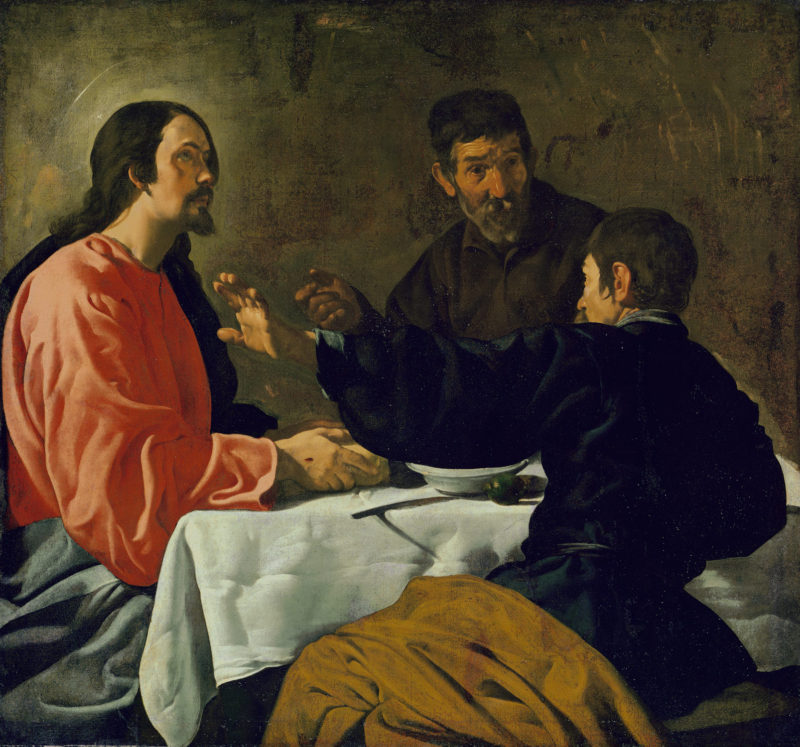
And he Just Smiled

Posted by Ben Bajarin | Posted in Kingdom of God, Resurrection of Christ | Posted on 09-10-2012

Step 1: Watch the video.

Step 2. Read the text below the video.

And on the third day He rose from the dead, and He…just…smiled.

Christus Victor indeed!

Covenant, Cross, Justification, and Christus Victor

Posted by Ben Bajarin | Posted in atonement, Kingdom of God, Resurrection of Christ, Sovereignty of God | Posted on 14-06-2012

I was asked a question, through email, recently about N.T Wright’s view of Justification. Since I wrote a long answer, I figured I would post it as well on our blog.

N.T Wright has a great book that I though was extremely useful called The Climax of the Covenant. In this book he outlines how Jesus and the cross were the climactic event of God’s covenant with Israel. The law was there simply to point out sin (the wrong) and provide insights on how to truly bear and steward the image of God. God’s covenant with Israel, in this perspective, is not that Israel as a people, nor the law, nor sacrifices, etc., were the answer or solution to sin, only that the answer and solution to sin would come through Israel. N.T. Wright’s analogy for this was that Israel is like the bomb squad whose job is to manage the bomb until the time is right then lay it at the foot of the cross. His point was more often than not Israel believed they were also to diffuse the bomb and this is not the case. So covenantal theology that understands the covenant and how Jesus fits as the story of Israel’s climax is a core point.

The second is a more holistic understanding of sin (the wrong). For this the law court metaphor works quite well and I think brings even deeper understanding than most evangelicals allow it to. To fully understand the law court analogy we have to have the judge (God), the defendant (humanity) and the plaintiff (satan) all present. For this an analogy from The Lion, The Which and the Wardrobe is helpful. I think C.S. Lewis was onto something with how he presented this scenario.

When Edmund, representing humanity, comes into the camp Aslan takes him and speaks with him. Aslan then comes out and announces that the matter with Edmund has been settled (between Aslan and Edmund), Aslan had forgiven him. All of this without a sacrifice and without a substitution (yet)… Then the White Witch enters and says not so fast Aslan there is a matter that needs to be settled according to the law, she (the law and satan) still had a claim against Edmund. As we all know Aslan takes his place thus dealing with the claim the White Witch (satan) had on Edmund (humanity) once and for all.

This view I think is a much more biblical presentation of penal substitutionary atonement. It is penal only in the sense of the matter of the law, and substitutionary in that Jesus took our place in the matter of satan’s claim on humanity thus setting us free once and for all. But it does not present an angry God or one where we are starting off on the wrong foot with and someone needs to take the punishment to fulfill God’s wrath. It is more about settling the matter with the one who brings the claim up because of the law.

So back to the courtroom setting. Because of the scenario above, the matter has been dealt with. Satan has accepted the substitution once and for all and released his claim thus acknowledging the matter has been resolved and he will not bring it up again. There is to be no re-trial.. Satan believed that the Son of God who is the only person who can threaten his Kingdom was going to be killed (and not raised again) and was a fair trade for all of humanity.

So Justification in light of all of this is simply God finding humanity to be in the right and of no wrong doing. N.T. Wright points out what is different from most evangelical views, including those like John Piper, which is that justification is not about imputed righteousness in that we somehow become or attain righteous attributes from God. It is simply only that we are found in the right and to be not guilty (even though we still are because we still sin) God does not even acknowledge it is there, it is gone, forever, not just covered, transferred, etc. There is no longer any claim against us because of Jesus because the accuser lost the right to accuse us any more in accepting the substitution.

This, I would contend, even when reading Paul’s covenantal theology and even his understanding of sin, law, courtroom, etc., that this view is the way Paul understood all the Jewish heritage, with the amazing act of the cross and now into the Kingdom where God is becoming King through Jesus (his words) because of the resurrection (Jesus’s coronation) of the Kingdom that is inaugurated but not yet consummated.

What IS a Christian, anyway?

Posted by Dan Martin | Posted in Challenging conventional doctrine, Creeds, Culture wars and Current events, evangelism, hell, Kingdom of God, Resurrection of Christ, Salvation | Posted on 28-10-2011

Transparent cross superimposed over a question markI had a friend ask me today what my definition of a Christian is.  I resisted the question to some degree, as I remain extremely troubled by the obsession many have, with drawing lines to delineate who is “in” and “out” of fellowship, orthodoxy, or whatever.  I am not taking anything back that I said in my Word About Creeds.  Nevertheless, if I claim to want people to submit to the lordship of Jesus Christ, it follows that I must have some idea about what this concept means…at least as I use the terms.

I hope I’ve made it obvious in my writing that while I believe the Christian church–particularly the church in the United States where I live–has severely messed up its witness and faithfulness to Jesus, I am not saying therefore that the people I criticize are (necessarily) not Christians.  It will give some Christians grief to see me quote the Quran at this point, but it’s eloquent when it says:

Unto God ye will all return, and He will then inform you of that wherein ye differ. (Al-Ma’idah, 5:48)

In other words, I presume that *all* Christians (and others, for that matter) get some things right, some wrong, and that our merciful Father will sort it out some day if, in fact, the sorting matters to him.

I am also not saying that all those who meet the criteria I give below are going to heaven, and all who aren’t are going to hell.  The issue of salvation is an entirely separate question–and in fact the wrong question to be asking at this juncture.

But with these caveats, I offer the following four criteria that I believe sufficiently define one who follows Jesus:

  1. Jesus’ Divinity.  The New Testament is quite clear that Jesus represented himself as divine, and any follower of Jesus must acknowledge him as such.  This is not the same thing as endorsing classical Trinitarianism…as I have previously written, I personally believe that the “co-equal person” argument in the doctrine of the Trinity fails to wrestle adequately with those scriptures in which Jesus clearly delineated himself as other than, and subordinate to the Father.  I use the term “wrestle” quite deliberately, as I believe there’s a tension in the scriptural characterization of Jesus that can’t be fully resolved.  The Trinity is one limited, inadequate attempt to resolve it; my own characterization of Jesus as divine but submissive to the Father is another.  Either is a genuine attempt to be faithful to the way Jesus characterized himself, and either, I suggest, fulfills this first criterion.
  2. Jesus’ Humanity. Just as the scripture is plain about Jesus’ divinity, it is categorical that from the incarnation on, Jesus became honest-to-goodness human flesh.  He ate, he bled, he suffered, he partied.  The Gnostic denial of Jesus’ flesh is outside the pale.  The follower of Jesus recognizes his true humanity.  (note in this and #1, I’m avoiding the classic phrase “Fully God & Fully Man.”  I think that phrase is actually nonsensical and does nothing to advance either understanding or orthodoxy).
  3. Jesus’ Death and Resurrection.  The incarnate, fleshly Jesus really, truly died and was really, truly raised to life by the Father.  The many theological implications of this fact are the subject of some dispute, and I certainly have an opinion on them.  But there are genuine Christians who have very different opinions than I on what Jesus’ death and resurrection accomplished.  They are still Christians, and so am I.
  4. Jesus’ Lordship. This is the point at which the I most clearly depart from the idea that a “credo,” a list of “what I believe,” is of utmost importance.  If one “believes” that Jesus is Lord, that “belief” can only be expressed in submission, obedience, and discipleship.  The fact that Jesus is Lord means that all the other things and beings that pretend to the throne are NOT lord.  Nations, individuals, belief systems, political philosophies & parties, all are subordinated to the call and command of Jesus, or else he isn’t Lord, and no amount of “believing” otherwise can change that.

I hope you noticed that all four of these criteria start with the name of Jesus.  That’s no accident.  It is the name of Jesus, and his position in your life, that makes you a Christian, or not.  And frankly, those who are, and those who aren’t, are to be found in some unexpected places.

Misplaced Passion

Posted by Dan Martin | Posted in atonement, Challenging conventional doctrine, Resurrection of Christ | Posted on 18-04-2011

In recognition of holy week, I’m going to resurrect a piece I wrote five years ago at Easter, after I saw the film The Passion of the Christ.  Released in 2006, the film itself is clearly not news; however, as recently as this month I’ve heard fellow Christians speaking positively—almost reverently—of the film and its portrayal of Jesus’ suffering.  Notwithstanding the excellent work on Jesus’ resurrection by N.T. Wright (Surprised by Hope – 2008), that subset of the church that I’ve seen still seems to be firmly in the grips of an affliction we might term hyperchristemia—an excess of Christ’s blood (or, more accurately, an obsessive focus on his blood).

Passion aroused no small amount of controversy when it was released.  No shock there; the figure of Jesus Christ seems rarely to inspire indifference.  I remain troubled, however, by precisely which subjects became the lightening rods of the controversy—and perhaps even more disturbed by those that did not.  I shouldn’t have been surprised, I suppose.  Public controversies rarely center around key issues, and this one was no different.  A consideration of the person and history of Jesus should definitely arouse passions, but not—I submit—primarily because of his so-called “Passion.”

I object to the content of the Passion movie, but not for the usual reasons.  Not because of the graphic brutality, though the sadistic orgy of Jesus’ flogging is certainly disturbing.  Nor do I consider the arguments over Mel’s perceived anti-Semitism, or the degree of historicity of his portrayal, to be issues of more than peripheral concern.  I object, rather, to the very notion that Jesus’ suffering and death comprise the central story at all.  I object to the line on some of the Passion posters:  “He lived to die.”  The message of the Christian gospel is nothing of the sort.  It is Jesus’ resurrection, not his death, which claims that central focus.

Though the film was neither unique nor original in this regard, Passion’s central message is that Jesus’ intense physical suffering and barbaric death comprise the ultimate climax of His life and redemptive work.  The film opens with a quote from Isaiah 53:  “He was wounded for our transgressions. . .by His stripes we are healed.”  The remaining two-plus hours appear to me primarily to demonstrate just how many brutal stripes were required to effect that healing.  Even the symbolic portrayal of Satan recognizing defeat comes at the very moment of Jesus’ death.  This doctrine, while common in both Catholic and Protestant Christianity, is fundamentally at odds with the Scriptural portrayal of our redemption.

He is Risen, He has Conquered, He Rules!

Posted by Dan Martin | Posted in Kingdom of God, Resurrection of Christ, warfare world view | Posted on 04-04-2010

Christos Anesti! Christ is Risen!

A joyous Easter to each of you.  This is the day when we celebrate Jesus’ victory over the powers and their grip on the world, for in raising Jesus from the dead, the Father achieved victory over the ultimate weapon of evil – death and our fear of death.

I was thinking this morning in church. . .we often look at the Genesis story of the fall as being the point where death entered the world, and to some extent we are supported in that view by Paul’s comments in Romans 5.  However, if we look at the biology of life, can we really say nobody would have died without the fall?  I wonder if perhaps Tolkein had it right (though he was writing fiction) when he portrayed death as God’s GIFT to man:  to be the transition whereby man passes from earthly life into a newer and closer existence with God, but that death itself became corrupted when man chose his own path to immortality instead of God’s.

I wouldn’t take this too far, in that we really don’t know all the details, but perhaps it wasn’t (and isn’t) biological death that is or ever was the enemy, but rather that death of that sort got corrupted along with everything else in creation and thereby became our enemy as it became a tool for separation from, rather than approach to, God.

This would make sense out of the fact that we still die, even as believers, but we need not fear death because in Jesus, death is not the end of the story.  The grave has not been eliminated, but it HAS been defanged:  “O death, where is thy sting?”  This is why John of Patmos was able to write in Rev. 14:13:  “Blessed are the dead who die in the Lord from now on. ‘Blessed indeed,’ says the Spirit, ‘that they may rest from their labors, for their deeds follow them!’”

So rejoice in the knowledge that your king defeated the enemy’s ultimate weapon of mass destruction–death as separation from God–and now invites us to live in, and work for his Kingdom from now until that Kingdom overtakes the entire fallen world.

Easter Should Make Rebels of Us All – a sermon link

Posted by Dan Martin | Posted in Resurrection of Christ, warfare world view | Posted on 03-08-2009

Over a late lunch today I listened to a podcast of a sermon from a minister whose page I found through another blog, and I want to share it with you. Andy Croel, over at The Pulpiteer, preached a good sermon this past Easter on the notion that death is NOT part of God’s plan, that Easter shows it, and how we ought to respond. I recommend it. Here is a quick excerpt:

In the resurrection of Jesus Christ, we see God’s plan for dealing with death…In the resurrection, mothers are not told why their children died: mothers are given their children back. In the resurrection, we are not told why disease is secretly good: we are healed. In the resurrection the effects of evil and death are undone. Death is shown to have no ultimate effects at all, because God can undo it in the blink of an eye…

Easter should make rebels of us all…when we see evil and injustice, when we see death and destruction, when we see natural disasters that wipe out villages and leave hundreds dead, we are not to be a people that try to come in and explain some ultimate meaning and purpose behind horrible tragedy and death. Instead, we are to speak of a God of salvation who came back to rescue his good creation: A God who doesn’t explain the tragic death of innocents, but rather raises them back to life.

He then goes on to challenge us to feed the hungry and minister to the suffering and dying, precisely because their hunger and suffering and death are the work of our enemy…death…defeated though it is by Jesus’ resurrection. If I may paraphrase, working for justice, in Jesus’ name, is an act of war.

The full sermon is here.

Atonement and the Resurrection

Posted by Dan Martin | Posted in atonement, Resurrection of Christ | Posted on 25-03-2009

Last week Trevin Wax posted a review of Mark Driscoll’s new book “Death by Love: Letters from the Cross” on his (Trevin’s) “Kingdom People” blog. It was a detailed and sympathetic review of a book that, according to Wax, concentrates heavily on the suffering and death of Jesus as it impacts the redemption of human sinners.

I was troubled, and I raised this question in the discussion, by the apparent lack of emphasis on the resurrection in this work. Wax’s response bugged me even more: “The book is specifically about the atonement, so it is natural that it focuses more on the death of Christ than the resurrection.” The more I thought about it, the more wrong that notion seemed.

There is no question that Scripture, particularly the Pauline epistles, teach us that Jesus’ death in some way dealt with the problem of corruption and sin and death in this world. But when the writers of Scripture talk about Jesus’ death, his resurrection is never far away. Think of all the gospel accounts where Jesus, while prophesying his death, says in nearly the same breath that he’ll be raised on the third day (Matt 16:21 &ff, Mat 20:17 &ff, Mark 8:31 &ff, Luke 18:31 &ff, and others). John is the only gospel where none of Jesus’ comments about his death are associated with resurrection in the same paragraph, though in John 14:18-19 Jesus is clearly talking in that vein.

But it’s not “just” Jesus who talked that way (I can’t believe I just said that). Paul, whose writings form the backbone of most atonement theology, flat-out said in 1 Cor. 15:17:

And if Christ has not been raised, your faith is futile and you are still in your sins.

It doesn’t get much clearer than that. While Jesus already had the authority to forgive sins before he died (see Matt. 9:2-7), Paul teaches us that it was his death and resurrection together that wielded the ultimate power over evil, over the principalities and powers of this age.

It occurred to me as I chewed over this, that perhaps the reason Jesus’ resurrection gets soft-pedaled so much in the church, is precisely because the prevailing view of atonement within the church is the Penal-Substitutionary notion that Jesus died in order to take upon himself the wrath and punishment of God for our sins. In P-S, the redemptive act was completed when Jesus “yielded up his spirit” on the cross. In fact, though P-S proponents wouldn’t actually say this, the resurrection is pretty much unnecessary in the view of penal substitution, except perhaps for the fact that like any bereaved father, God wanted his son back (I won’t get into a discussion on christology here). Maybe this is part of why P-S seems so inadequate to me.

But in the Christus Victor view, which comes much closer to my own position at this time in my life, the resurrection is absolutely essential. When Jesus died, Satan and the powers actually thought they had won. From Genesis to Revelation, we see that death is the ultimate weapon of evil against the purposes of God. When they managed to kill the Son of God, they thought they had triumphed and their ultimate weapon had taken down their ultimate enemy. It was when God raised Jesus from the dead, that Satan’s greatest weapon of mass destruction was rendered powerless. Satan’s defeat happened Sunday morning, not Friday afternoon!

Therefore, I contend, as subjects of the resurrected King, we have no business going on about Jesus’ death for a whole book without spending much more energy on celebrating and proclaiming his resurrection.

We were buried therefore with him by baptism into death, in order that, just as Christ was raised from the dead by the glory of the Father, we too might walk in newness of life. For if we have been united with him in a death like his, we shall certainly be united with him in a resurrection like his. . .We know that Christ, being raised from the dead, will never die again; death no longer has dominion over him.

Romans 6:4-5, 9 (ESV), emphasis added

That “no longer” intrigues me. Is Paul saying that, for Friday night and all that Saturday, death DID in fact have dominion over Jesus? We don’t know, but death’s owner certainly thought so. He hasn’t learned much either. Death is still the ultimate threat that the powers of this world (human or otherwise) try to hold over us. It is only in the certainty of Jesus’ resurrection that we can know that he has the power to save us. His blood alone was not enough for that!