When Christians speak of violence in Islam

Posted by Dan Martin | Posted in Creeds, Culture wars and Current events, Islam | Posted on 21-04-2013

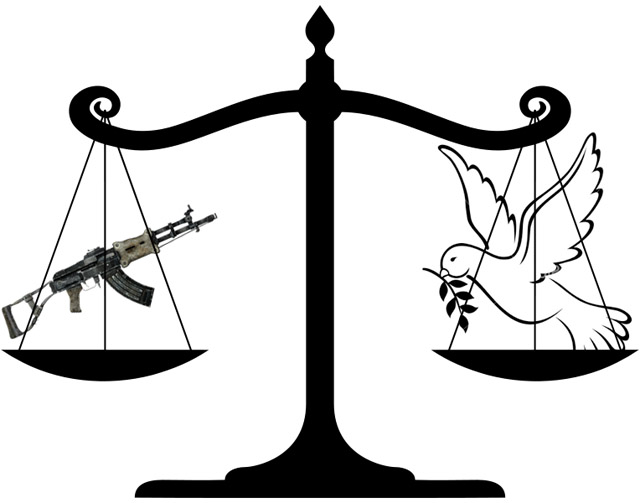
Battle of the FaithsThe recent bombing attacks in Boston have once again raised the cry across the internet, rehearsing the perceived violence of Islam.  In several recent discussions, Christians have repeated the mantra that the Qur’an is filled with commands to commit violence against non-Muslims.  Islam, they say, is an inherently bloodthirsty faith.  Commonly cited as empirical fact are screeds such as this one:  “The Quran contains at least 109 verses that call Muslims to war with nonbelievers for the sake of Islamic rule.”

It is important to note that these statements are made by people and on websites whose express purpose is to “expose” or “correct” the claim that Islam is a peaceful religion.  Frequently, such sites manifest considerable antipathy toward Islam and Muslims … for example the home page banner of the above-linked site describes Islam as “one really messed up religion.”  To put it kindly, the source of this purportedly-objective information is not remotely unbiased.

I propose an experiment for anyone interested:

  1. Find an atheist. Not just an unbeliever, but someone who really hates Jesus.
  2. Have that person start with the assumption that Christianity is a violent religion.
  3. Now have him go through the Bible looking for proof of his preconception about our violence.  Be sure he doesn’t overlook the places where “a man after God’s own heart” (1 Samuel 13.14) celebrates the orphaning and widowing of his enemies’ families (Psalm 109:8-10). Be sure he lingers over the various causes of stoning people to death, and the genocides of the Pentateuch and Judges.
  4. Check how many violent verses, from Genesis (or at least Exodus) to Revelation, your anti-theist finds.  Now convince him you worship a God of love and peace.

I hope you would object “but you have to understand the historical and literary context for those verses … progressive revelation, the nature of God revealed in Jesus Christ, old and new covenants, etc.  No one can fully understand those things who has not studied them in a perspective of submission to the God who inspired them.”  I agree.  This is a perfectly reasonable objection, whether you’re talking about the Bible or the Qur’an.  The fundamental truth is that it takes a person of faith to accurately interpret the texts of that faith.  If I want to know what the Bible means, I’ll ask a Christian, not a Muslim.  If I want to know what the Vedas mean, I’ll ask a Hindu.  If I want to know what the Qur’an means, I’ll ask a Muslim.

Furthermore, sola scriptura biblicist that I am, it is still true that to understand a faith or a “religion” (I really hate that word) requires more than merely dispassionate study of its texts (or even passionate study, for that matter).  Whatever one thinks of the thing called “Christianity,” one cannot really know it without interacting with a Christian–or many different Christians.  The community, the rituals, even some of the language, and yes–the sacred texts–are unintelligible without a knowledgeable insider to function as an interpreter.  If you don’t know any Christians, you don’t know Christianity.  If you don’t know any Muslims, you don’t know Islam (you may not, anyway, but I digress).

I am not suggesting there isn’t a whole lot of horrible violence committed by Muslims in the name of Islam.  There is.  One doesn’t have to be a Fox News devotee or a Limbaugh dittohead to see the headlines.  But when other Muslims I know and trust tell me that those violent, radical Muslims are abusing and even violating the Qur’an, I believe them.  Why do I believe them?  Because I have seen plenty of violent, radical Christians abusing and violating my own holy scriptures as a pretext to commit terrible acts … why should I expect it to be any different to other religions?  Satan corrupts everything.

We must oppose the bearing of false witness against our neighbors, and against those we style as our enemies.  But even that isn’t enough.  It grieves me deeply that when arguments such as the “109 violent verses” are used, they are usually in the context of opposing Muslims who are trying to make peace with us, or opposing Christians who are trying to make peace with Muslims.  This is not only tragic, it’s monumentally stupid.  If we have an ounce of self-preservation instinct at all, we should welcome anybody who extends an olive branch to anybody else.  To whatever extent any Muslim is a threat to me, it’s not the one who is preaching peace from the Qur’an who poses that threat.  We would also do well to remember that our Lord said “blessed are the peacemakers.”  He did not qualify that phrase with the adjective “Christian.”  Neither, I believe, should we.

The Lamb That Was Slain – A Passover/Easter Reflection

Posted by Dan Martin | Posted in atonement, Kingdom of God, Salvation | Posted on 30-03-2013

dali-last-supperThis Holy Saturday, between Good Friday and Easter, I was reflecting on the idea of Jesus as the slain Passover lamb.  The association is certainly Biblical, not only in the obvious context of Jesus’ death taking place on Passover, but also in the testimony of the Apostle Paul in 1:Cor. 5:7.  Paul doesn’t go into detail what he means about Jesus being the Passover lamb, but if we look carefully I think there are some helpful hints to be gleaned … hints that suggest Jesus’ shed blood means a great deal besides forgiveness of sins.

The Passover sacrifice is, of course, introduced in Exodus 12.  In this account, God instructs Moses to tell the people of Israel to slaughter a lamb and do two specific things with it:  mark their doorposts with its blood, and eat the flesh for dinner.  In stark contrast to the usual Christian narrative of sacrifices being for sin, I find it notable that the concept of sin does not appear in the entire tale from Exodus 11-13.  Both actions–the blood and the flesh–have a very specific purpose, and  neither is related to sin at all.

First, the Israelites were to mark their door frames with the lamb’s blood “as a sign.”  Those whose houses were so marked would not suffer the death of their firstborn, as happened to the rest of the households of Egypt.  It’s important to recognize that God didn’t “need” the label; some (though not all) previous plagues specifically spared the Israelites in Exodus 8:22 (flies), Exodus 9:24 (livestock died), Exodus 9:26 (hail), and Exodus 10:23 (darkness).  So the sign of the blood clearly was intended for the Israelites themselves, not so much for God and the angel of death.  Nevertheless, the sign was clearly one of identification.  The blood on the door marked a household not only as of the people of God, but people who had deliberately obeyed God’s command.  It was not the shedding of that blood–the sacrifice itself–that spared the Israelites from the death plague, but rather the application of that blood according to God’s instructions.  Might this be consistent with a God who prefers obedience to sacrifice (1 Sam. 15:22, Hosea 6:6)?

Second, the Israelites were to eat the roast flesh of the lamb.  No symbolism is given for this in the Exodus text, and in fact the only instructions are that it should be roasted not boiled, that it be eaten in haste and with unleavened bread, and that any leftovers be burned.  Without trying to extrapolate too much, I honestly wonder if this may not have been a highly pragmatic command for the simple reason that the people were about to travel on foot out into the desert, and they simply needed a good protein-and-carbohydrate meal to fortify them for the journey.  God’s commands can get downright practical at times.

We Christians pay too little attention to the Passover links to Jesus, I think.  Passover is the time when God called his people out of a foreign place, saving them from slavery, and in a very real way making them into “his people” in a way they had not previously been.  On the eve of their salvation, on the threshold of a new life as a newly-created  nation, God’s people were labeled by blood and strengthened by flesh of a sacrificed lamb.  Paul says something quite similar in Ephesians 2:13-14, where even we Gentiles have been “brought near by the blood of Christ,” and separate peoples have been made into one “in his flesh.”  Jesus told his disciples to eat of his flesh and drink of his blood at the Passover meal.  Just as God initiated a feast of remembrance on the eve of delivering the people of Israel, Jesus instituted a new meal of remembrance as he set in motion the new kingdom of his Body.  The body of Christ as well as the blood; the bread as well as the cup, is given to humans to unite and seal us as the people of God.  In his broken body and shed blood, we are marked as different, set apart from the death that rages around us, and ushered into a new kingdom.

There is much more in the Bible about the blood of Christ, and I don’t suggest for a moment that the Passover narrative is the whole story.  Still, it is one we should remember.  This “day of remembrance,” this “festival to the LORD,” is to remind us of our deliverance, our calling, our unification as the people of God.  Let us not forget.

Why do I believe? Part 6 – My heritage

Posted by Dan Martin | Posted in Apologetics, Creeds | Posted on 23-03-2013

I'm not actually Jewish, and this image is of a Jewish mezuzah, a container for a bit of scripture placed on the doorpost of a home.  But to me, the mezuzah illustrates the concept of parents passing on their faith to their children, and is therefore relevant to this topic.

I’m not Jewish, and this image is of a Jewish mezuzah, a container for a bit of scripture placed on the doorpost of a home.  But the mezuzah illustrates the concept of parents passing on their faith to their children (see Deut. 4:6-9), and is therefore relevant to this topic.

Not all my reasons for belief are evidence based.  I say this without shame and without apology.  I am at least in part a product of my own upbringing, both from the standpoint of what I was taught, and the societies in which I have passed much of my life.  So, I would suggest, are we all, and no less so if we reject our past, than if we accept it.  I would explain this in part by saying that there are a variety of forces that lead to one’s position on the Belief Matrix I’ve discussed before.  Differing bits of evidence may have vectors that impel one toward theism or atheism, or may affect the certainty level of the other axis on the matrix.  My own history pushes me in the direction of theism.

It does much more than that.  I grew up learning of Jesus in the context of a family that did not have tight denominational ties, but was strongly influenced by the Anabaptist movement, and the Mennonite Church and Church of the Brethren denominations.  While I do not fellowship with either group today, and while my positions are quite distinct from those of my parents in a number of ways, it is an incontrovertible reality that my basic Christian focus, my aversion to ecclesiastical authority, and my particular form of Sola Scriptura exegesis owe a great deal to my Mom and Dad (if you want proof of that, just spend a little time browsing my Mom’s blog).  I believe I’m my own man, but there’s no question I’m my parents’ son too (thanks Dad & Mom!).

There’s plenty of what I’ve come to believe that I did not learn from childhood.  Peruse the topical index on this blog and you’ll come across topics such as Open Theism, my questioning of the doctrine of the Trinity, or the nuances of my perspective on nonviolence, all of which came well after I left home, though I would argue they remain grounded in the same approach to biblical authority.  I’m a product of my upbringing, but I’m no clone.

Likewise, though I ground many positions (particularly ecclesiology and nonviolence) in the Anabaptist movement of the sixteenth and seventeenth centuries, and though I have literal as well as figurative ancestry among the Anabaptists, I do not follow their lead without question.  I am no more in full agreement with every article of the Schleitheim Confession of the Anabaptists, than I am with the Nicene Creed to which I’ve previously objected.  I have taken the raw material I was served, including my parents’ faith and the teachings of my church(es), combined it with my own independent reading of the Bible, seasoned it with the thoughts of many others both published and not, and come up with a faith that is mine today.  This is a faith that is in some ways distinct from all my prior influences, but to deny their influence would be downright silly.

An important caution is in order, though.  I acknowledge the influence of my upbringing on my beliefs, but I know many who seem to believe that the way to be free of such influence is to reject whatever they were taught.  Nowhere have I seen this attitude in sharper relief than among those who, decrying the legalism or “narrow-mindedness” of their parents’ faith, profess atheism (or more honestly, anti-theism).  It takes but little reflection to realize that one who rejects his upbringing out of hand is influenced by that upbringing just as surely as one who accepts it.  “X” and ”Not X” are indistinguishable in one vital respect–both are equally and inextricably referential to “X.”  One can–and I believe ought to–attempt to step back and evaluate one’s heritage.  Such an exercise, if done honestly, likely will result in keeping some elements, refining others, and discarding still others.  But one cannot reasonably deny that one’s heritage has an influence.  Mine certainly has.

********************************

One parenthetical note:  it is the reality of the influence my culture and upbringing has had on my own philosophy, that as much as anything informs my reluctance to accept the exclusivist claims many Christians (and maybe others) make about faith.  The vast majority of humanity see the world as they do, in large measure due to an accident of birth.  The world’s religions are geographically distributed, and while there is certainly overlap, it’s a reality that a person born in China is likely as not to be Buddhist; one born in India, Hindu; one in Latin America, Roman Catholic; and one in the Middle East or North Africa, Muslim.  I have written before that while I am not strictly universalist, I do not believe the Bible supports the common Christian claim that anyone who hasn’t appropriated Jesus’ salvation as they define it, is damned.  I rather lean toward the principle of “Available Light” (expounded at length by Moxey and Garrett, as well as the older Quaker concept of Inner Light) … that God evaluates each person’s response to that truth which has been revealed to him/her.

Why do I believe? Part 5 – A parenthetical apologia

Posted by Dan Martin | Posted in Apologetics, Challenging conventional doctrine, Creeds, evangelism | Posted on 26-02-2013

220px-ApologiaOne of the greatest comedy movies of all time, I am convinced, is The Princess Bride.  And one of my many favorite lines, when Inigo has heard Vizzini describe one too many things as “inconceivable,” is “You keep using that word.  I do not think it means what you think it means.”  Well, that can certainly be said about apologetics, as I realized when a friend described his study of the subject a few days ago.  Since I’m in the middle of an apologetics series myself, and since I really don’t intend what many apologists do, it occurs to me that I ought to explain myself…to do an apologia of my apologia, as it were.

Take a look at any of several online etymologic dictionaries, and you’ll see that the term “apologetics” and the related word “apology” come originally from the Greek ἀπολογία (apologia), which was the term for the defense in a court of law.  It’s actually the term used in the New Testament when, for example, Paul made his defense before the crowd in Jerusalem (Acts 22:1), and by Festus when he’s describing Paul’s secular right of defense (Acts 25:16).  Perhaps more to the point of Christian apologetics, it’s the word used for the answer that Peter says we should be ready to give, when someone questions the reason for our hope (1 Pet. 3:15).  I find these uses interesting in that in each case, the defense is offered, not proactively, but rather in response to the questions or charges of another.  This alone may be a relevant object lesson.

There is, however, a different stream in Christian apologetics that we must acknowledge.  For want of a better term to characterize it, I’ll call it “pre-emptive apologetics,” or perhaps even better, “offensive apologetics” (and here I refer primarily to “offense” as the antonym of “defense,” not as the causing of emotional grief, though that is certainly a frequent secondary effect).   It’s what I see happening all over the Evangelical blogosphere, and it’s the attitude I often hear from some who style themselves apologists today.  There are many who seem convinced that sufficiently-compelling constructive arguments (often combined with the destruction of an opponent’s objections) will compel a person to adopt faith in Jesus, rather as CS Lewis testified was the case for him (“the most dejected and reluctant convert in all England,” he said of himself).

I’m actually dubious that pure conversion-by-argument is even possible, but whether it is or not, that is most emphatically not my purpose with this series.  Philosophically speaking, it seems to me rather counterproductive to attempt to win someone to grace by defeating them with reason.  Furthermore, confrontational apologetics maintains the focus on faith as propositional rather than practical … on winning a contest of belief rather than inviting the thirsty to drink.  I’ve maintained for years that credalism puts the focus on the wrong things; popular apologetics puts the focus on credalism.  Guess I’m at least consistent.

So what am I trying to accomplish?  Actually, I’m sorting through my own challenge to myself.  My life of faith, while (I hope) firm in conviction, has been essentially devoid of the experiential or the transcendent … the “relationship with God” so many Christians talk about.  As I’ve repeatedly expressed on this blog, I’m also deeply disturbed by the behavior of many who call themselves “Christians,” particularly when, as Gandhi observed, “your Christians are so unlike your Christ.”  I still struggle with why God seems to let such blatant misrepresentation of himself go unchecked, and often as nearly as I can tell, unanswered.  Yet I remain stubbornly chasing after some halting, imperfect attempt to follow Jesus.  I’m trying to explain why … to myself, and to anyone else who cares to listen.

I don’t know if what I’m writing will “convince” anyone else.  If it does, that’s God working in them, it’s for sure not the dazzling cogency of my thoughts and writing.  If I’m trying to convince anybody else of anything at all, it’s that it is possible to validate a lot of objections atheists and antitheists throw at the church (and I do think many of those objections are valid), and still come finally to a point of faith.  Well, and maybe one more thing … if I can convince a few Christians to let up, to show a little more grace and a little less self-assuredness, I’d consider that progress.

Why do I believe? Part 4 – Cosmology and Creation

Posted by Dan Martin | Posted in Apologetics, Creeds, Culture wars and Current events, evangelism | Posted on 23-02-2013

Carina-NebulaThe heavens are telling the glory of God;
    and the firmament proclaims his handiwork.
Day to day pours forth speech,
    and night to night declares knowledge.
There is no speech, nor are there words;
    their voice is not heard;
yet their voice goes out through all the earth,
    and their words to the end of the world.  (Ps. 19:1-4)

Part of the reason I believe there must be a Creator is because I look around me.  I was raised in the home of an astronomer, so I’ve been enjoying the beauty and grandeur of the cosmos since childhood.  There is a sense that comes in observing in the beauty of the universe, that it got that way because somebody cared to make it that way.  From awe-inspiring views of nebulae and galaxies, the grand solitude of the mountains, the raw power of the ocean, to the incredible intricacies of life small to large, humanity has been inspired for millenia to conclude that all this was made for a reason.

This is not an argument for “Intelligent Design” and the people at “Answers in Genesis,” whose pseudo-science disgusts me to such a degree I refuse to link to it (Google it if you must).  There is, in my view, far too much solid evidence for the age and size of the universe, and for evolutionary processes in the development of life, to go down the various “Creationism” rabbit holes (for those who want to explore a thoughtful Christian approach to evolution, check out Biologos.org).   And since I don’t subscribe to a so-called “literalist” interpretation of the whole Bible, I have no particular reason to fear that science might challenge the basis of my faith.

But neither does my grounding in at least the basics of both cosmic and biological evolution challenge my conviction that there’s some sort of creator behind it all.  I think the so-called “Big Bang” theory does a pretty good job of describing much of what we observe on a cosmic scale–heck, I often joke that part of why guys like me enjoy explosions, fireworks, etc. is because we’re created in the image of a God who started it all off with the ultimate in fireworks.  Frankly, the idea that a singularity would cut loose with the necessary energy and matter to form the entire observable universe, almost demands someone or something to pre-exist that singularity and fire it off … and the notion that it would just appear out of nothing seems to me a much greater stretch than considering a creator.

Similarly with biological evolution.  That organisms change and adapt over time is obvious even on timeframes we can see, and nothing is stronger evidence for this than the frightening rate at which pathogens are developing resistance to most of the antibiotics we use to treat them.  I’ve only read excerpts, but Dr. Francis Collins book The Language of God: A Scientist Presents Evidence for Belief is a good place to look at how our DNA provides solid evidence for evolution.  Nevertheless, I believe the incremental nature of evolution–minute changes generation by generation, reinforced or eliminated by natural selection–is insufficient to explain at least two major thresholds in the development of life:

The first, of course, is life itself.  We can demonstrate that amino acids in a soup can organize into random patterns that might encode for proteins, but we’ve never observed any such soup make the leap from chemical organization to living organism, let alone living, reproducing organism.  That leap is not evolutionary, it’s revolutionary.  Igniting the fires of life required far more than lucky chance, a lucky mixture, and a lot of time.  I suggest those fires were deliberately set.

Second, assuming single-celled organisms that reproduce, their reproduction is by mitosis, or cell division.  It’s not a stretch to conceive that over time a colony of such reproducing organisms might begin to differentiate such that tissues with distinct functions begin to work together better as a multicellular organism instead of a blob all doing the same thing.  But it’s a leap of epic proportions to have organisms, whether single- or multi-celled, begin the process of sexual reproduction–a process that requires a variety of structures and systems all work together to facilitate the exchange of nuclear material between them, and the incorporation of that material into a third organism not entirely like either of the two parents.  So many systems need to be in place–systems that are completely useless until the reproductive process works as a complete unit–that again the development of this mechanism is revolutionary, not evolutionary.

So I see evolution as an obvious part of how life develops, but I still see a creator as the most probable explanation for the origin of that life, and the impeller of those revolutionary steps that life could not take on its own.  Still further down the developmental path, I rather suspect that sentience, self-awareness, and finally the desire to seek the divine (what C.S. Lewis referred to as “Homo divinus“) are all additional points of revolutionary change.  This perspective even harks back to Genesis (understood in a mythic form), when the writer tells us that God “breathed into [man's] nostrils the breath of life, and the man became a living creature” (Gen. 2:7).  The Septuagint provides an interesting understanding of those words, in that the “breath of life” is πνοὴν ζωῆς (pnoen zoes)–”pnoe” being the word also translated “spirit” (including Holy Spirit) or “wind,” and “zoes” referring to biological life; and then man became a “living soul” (KJV) which in the Septuagint is  ψυχὴν ζῶσαν (psuchen zosan) where the “soul” or “creature” is the word from which we get “psyche” or “psychology.”  In other words, God specifically gave the man life (God’s breath), but also gave him his psyche, which we might understand as cognition and self-awareness.

(It’s unfortunate that certain streams of Christianity have felt it necessary to set up their interpretation of Genesis in contradiction to observed biology, geology, and astronomy.  It was not ever thus, in fact Christian opposition to evolution comes much later than Darwin himself, and in fact one of Darwin’s most ardent contemporary supporters, Asa Gray, was a confessional Christian.)

There is one more point about the universe as we experience it that, to me at least, strongly leans toward the existence of not just a creator, but a benevolent one at that: beauty and our perception of it.  There is much I see around me that is just nonsensically lovely.  Whether it’s the many astronomic objects I’ve seen through my Dad’s telescopes (or the Hubble website, for that matter), the cardinal chowing down on our bird feeder just outside my window, or the gratuitous color display of thousands of sunsets, I find myself often struck by beauty that both in itself, and in my enjoyment of it, is completely unnecessary to our survival, reproduction, or any other evolutionary pressure.  There is evil and ugliness too, and I’ll get to those in a later post.  But they don’t, to me, diminish the reality that we experience beauty that doesn’t have to exist…beauty that is more, I suspect, than the result of happy chance.  I think it’s a gift.

I want to be perfectly clear:  none of what I’ve just described necessitates a Christian worldview.  As I said last month, “The heavens declare the glory of God…” says the Psalmist David (Psalm 19:1), but they don’t actually show us God’s name.  This is one of the points where the Intelligent Design folks get it badly wrong, in that they think once they’ve “proven” creation, their version of fundamentalist Christianity must follow.  In point of fact, people studying the heavens have come up with a pretty diverse set of creation myths and cosmologies down through the ages.  C.S. Lewis (I think…can’t find the quote at the moment) actually suggested that this very fact — that people see the divine in creation — is evidence for the existence of God.  I’m not sure I completely buy his conclusion, but it is nevertheless true that people who have been inspired by creation to envision a creator, have come to starkly different conclusions about that creator’s identity and character.  To find Christ (or not) requires different evidence altogether.  But on the schema of my Belief Matrix, I find the physical world to be strongly suggestive (note I did not say “conclusive”) of a creator, so this evidence, to me, tends heavily toward the Theism side of the curve.

“Speaking of Jesus – The Art of Not-Evangelism” by Carl Medearis (book review)

Posted by Dan Martin | Posted in Apologetics, Challenging conventional doctrine, Creeds, Culture wars and Current events, evangelism, Salvation | Posted on 28-01-2013

This is a review, but mostly a recommendation, of Carl Medearis’ book Speaking of Jesus – The Art of Not-Evangelism.  I’ll get to the review in a minute, but I’ll start by saying up front:  seriously, this is a book you should buy and read.  If you’re a Christian who’s interested in evangelism, you should read it.  If you’re sick to death of Christians trying to evangelize you, you should read it too.  And if you think there’s something sort of cool about Jesus and can’t figure out why those Christians yammer on about Jesus but seem so not like him, you REALLY should read it!

This book is not new … Carl published it in 2011 and somehow I only learned about it a couple weeks ago.  But I’ve been in dialog with Carl over Facebook for a year or two, mostly around the topic that it’s possible to be unapologetically a fan of Jesus and still have Muslim friends, and even talk with those Muslim friends about Jesus.  He does this through the crazy notion that if you actually love people and treat them as friends instead of, say, part of the “enemy” or the opposing team, they often reciprocate.  He also has this weird idea that if Jesus really is as powerful and important as we say he is, maybe meeting Jesus is more important than thinking the right stuff about Jesus.  So Carl lays out the case for realizing that introducing people to the person, character, and way of Jesus is something entirely different from trying to “win” them to a religion.  As he says in the book:

I don’t want to redefine salvation.  I don’t want to redefine the gospel or even Christianity on the whole.  I suppose I want to undefine them.  I want to strip away the thousands of years of graffiti painted onto the gospel, turning it into a reasonable code of doctrines.  The gospel is not an idea.  It is not a belief.  It is not a favorite verse.  The gospel does not live in your church, it cannot be written down in a simple message, and it is not the sinner’s prayer.  The gospel is not a what.  It is not a howThe gospel is a Who.  The gospel is literally the good news of Jesus.  Jesus is the gospel.

(emphasis in original)

People who’ve read my blog for any time know that one of my recurring frustrations is when people are driven away from considering the claims of Jesus, not because of who Jesus is, but because of the jerks we Christians can be (see this post if you want a refresher).  Under the guise of the “offense of the gospel,” Christians can be a downright offensive bunch at times.  As Carl put it, “We often blame Jesus when our evangelistic efforts fail … I don’t think it’s Jesus they aren’t liking.  It might be you.”

This book is a great thought-provoker.  One more quote to whet your appetite:

Maybe you’ll read this and think that I’m trying to make salvation easier or make a way for all the gays and liberals and Muslims and Buddhists to get in without going through all the “proper channels.”

Maybe yes and maybe no.  I’m not trying to change what salvation is because salvation is not my responsibility.  God didn’t put Carl Medearis in charge of deciding who stays and who goes.  That’s Jesus’ job, and He can keep it.

My job, no–my joy comes from sharing the good news of Jesus with people.  I point to Him, and He does all the heavy thinking.  I don’t have to convince anybody of anything.

I let Jesus run His kingdom.

Pretty good advice, if you ask me.  Go get this book and read the rest!

Why do I believe? Part 3 – Parsing the question(s)

Posted by Dan Martin | Posted in Apologetics, Creeds, evangelism | Posted on 26-01-2013

Transparent cross superimposed over a question markI made a statement at the end of a previous post on this subject, that needs a little explanation.  I said “I believe, and will attempt to show in future posts, that a preponderance of the evidence supports the existence of God, and that further evidence pushes me to the Christian interpretation of what that God does and wants.”   Tucked into this sentence is a point I need to clarify, which will seem self-evident to some readers and completely novel (even offensive) to others.  It is this:  The truth of Jesus does not necessarily follow from acceptance of Theism.

There is a common error among many Evangelical Christians (and some others) I have known, that the opposite of Christianity is atheism, and conversely the opposite of atheism is Christianity, as though faith is a merely a single, bivalued choice.  The claim is silly on the face of it, and it results in such ridiculous claims as calling Muslims or Hindus as atheists simply because they don’t believe in “the God of Christianity.”  We Christians aren’t the only ones to make such dumb assertions; I’ve run across some statements by radical Muslims that were pretty parallel, and I’ve also encountered some atheists who seem to think that if one card is plucked from the Christian stack the whole house must tumble (a point, amusingly, that they share with the “Answers in Genesis” types).

I suggest rather that the question of the existence (or not) of God is an independent one from the choice of Christianity as a faith practice.  As a different choice, it needs to be resolved on different evidence.  There certainly can be overlap…as CS Lewis and Josh McDowell (among others) have pointed out, there are claims in Christianity that would be necessarily false if in fact there is no God at all.  But the converse–that if there is a god then Christianity is necessarily true–is nonsensical.  “The heavens declare the glory of God…” says the Psalmist David (Psalm 19:1), but they don’t actually show us God’s name.  Societies throughout time, in fact, have looked at the heavens and concluded they must be created by someone(s) worthy of glory, but they have come up with wildly different notions about who that someone might be.  This is why I was careful in my Belief Matrix post, to discuss the spectrum between Thesim and Atheism, and not to bring the many variants of Theist belief into the question.

I acknowledge that plenty of people have come to their conclusions about God through a specific encounter with Christianity (or, as some would characterize it, with Jesus himself).  If one is attracted to Jesus and takes all of Jesus’ claims seriously, theism certainly comes with the package.  I certainly know of many who were attracted first to the life and behavior of one or more followers of Jesus, and came to their perspective on the divine through learning from those people whose lives they admired.  I rather suspect the same may be true of some Muslims, Hindus, Buddhists, and others as well.  I do not mean to suggest that the systematic way that I’m approaching this subject is in fact a path for anyone to convert (remember I said at the outset that this series is an attempt to explain where I am, not to convince anybody else).  It is, however, important to recognize that underneath a claim of faith there can be a number of things that are being represented as true:  things which, while they may cohere into a system of sorts, do not necessarily follow from each other in an inseparable chain.

As I alluded in my Epistemology post, I don’t think that there’s a clear line of reasoning that I can lay out, starting with one or two assumptions, adding a bunch of facts and observations, inferring some logical points and coming to a conclusion of faith in Jesus Christ.  For me it’s a series of disparate elements coming from orthogonal directions which, taken together, nudge me in a certain direction.  But I still think there is value in separately examining the evidence for and against Theism, and the evidence for and against Jesus specifically, if for no other reason than that people have been all too careless in lumping them together.  This is what I will turn to in the next few posts.

There is one final issue I should highlight here though.  I’ve had a couple off-blog conversations with people who’ve suggested that by highlighting what I do or don’t “believe” in this series, I’m missing the point.  They are partly right, as anyone who’s read my work over time will know, I’ve made the case before myself.  Discipleship–that is, living like Jesus in community with others who want to live like Jesus–is far more important than correct doctrine.  In this series, I suppose I’m partly allowing myself to be drawn into the “doctrine” question even though I really do consider it to be of secondary importance to the lordship of Jesus and what that means (ought to mean?) for our lives.  Nevertheless, to those who say to me that none of this matters if you just (1) meet Jesus, or (2) look at Jesus’ disciples, I have to respond that first of all, I haven’t “met” Jesus in the way the (1) folks are talking…I’d like to, but I haven’t (this post may be helpful here).  Secondly, if I had to rely only on what I have been able to “come and see” of those who claim his name, I don’t think I’d be a Jesus follower at all.  What I have seen, far too frequently, is either antithetical, or at best tangential, to the claims of Jesus himself.  Consequently, I need a different evidentiary path to explain why I haven’t just chucked it all by now (which I haven’t).  It is that path–my own weird, convoluted path–that this series is exploring.

God’s decrees never lack power … an Advent meditation

Posted by Dan Martin | Posted in Immutability of God, Other Interesting Stuff, Sovereignty of God | Posted on 25-12-2012

“Nothing is impossible with God.”

"The Annunciation," a painting by William Brassey Hole

"The Annunciation," by William Brassey Hole (1846-1917)

We know this … we believe it … we confess it with our mouths.  It’s a great theoretical statement that underlies our confidence that God cannot be defeated.  But this thought can also be a bit distant.  Just because God can do something, just because God is all-powerful, doesn’t necessarily impact our everyday lives.

In Luke 1:26-38 is recorded the story of the angel Gabriel’s visit to Mary, telling her that God has chosen her to bear his son.  We all know the story … Mary is amazed and asks Gabriel the quite-natural question “how is this going to happen, since I’m a virgin?”  Gabriel’s answer, as recorded in nearly every Bible translation I can find, contains this statement:  “Nothing is impossible with God.”

An Advent meditation isn’t usually the place to critique Biblical translation, but according to the original text, that isn’t actually what Gabriel said.  The declaration recorded in the Greek manuscript of Luke 1:37 is much more potent, and much more tangible.  Literally, Gabriel’s words were “not powerless is any decree from God,” or to phrase it better, “God’s decrees never lack power.”

We’ve heard this sort of language elsewhere.  Perhaps the most eloquent expression of it is God’s word through the prophet Isaiah:

For as the rain and the snow come down from heaven,
and do not return there until they have watered the earth,
making it bring forth and sprout,
giving seed to the sower and bread to the eater,
so shall my word be that goes out from my mouth;
it shall not return to me empty,
but it shall accomplish that which I purpose,
and succeed in the thing for which I sent it. (Isaiah 55:10-11 ESV)

This is so much more than just God’s ability.  Gabriel’s testimony to Mary, and to us, is that when God says he’s going to do something—when he issues a decree—he both can accomplish it, and he will.  Because nothing is impossible with God, yes.  But more so, because God keeps his word, and his word is powerful.

And if this is true of God’s word of decree, how much more so the Word which became flesh and dwelt among us!  That Word, sent to this world because God loved the world so much he didn’t want to leave it to die.  Jesus became a man because of that love, and he came with power.  The darkness around us not withstanding, the purpose for which Jesus came will succeed …

because God’s decrees
NEVER
lack power!


(Originally published in an advent series for our church)

The Belief Matrix – A functional description of evidence and theism/atheism

Posted by Dan Martin | Posted in Apologetics, Creeds | Posted on 20-11-2012

In response to my previous post on the rules of evidence for my apologetics, a friend of mine who is himself a seeker of truth pointed out to me that I probably mischaracterized agnosticism as a simple midpoint between theism and atheism.  As he quite correctly pointed out, one can be an agnostic while leaning toward either atheism or theism, and that even agnosticism has at least two important variants:  those who believe one cannot know the truth about the existence or not of a divine being, and those who believe that we simply have insufficient evidence to know.  He was right on both counts.  But the more I thought about it, the more I realized that the relationship between strength of belief and theism/atheism could be visualized as independent variables in a bivariate function, and that doing so might shed some light on my own perspective.  So I invite you to consider the following graphic to which I have given the working title “The Belief Matrix,” though that title may not survive further discussion:

A graphical representation of a functional relationship between certainty and theism/atheismAs you can see, in the above graphic I have represented the spectrum of Atheism to Theism along the X axis, with the degree of certainty of one’s belief as a scale from zero to 100% along the Y axis.  I suggest that most people’s stance with regard to the existence or nonexistence of a divine being (any divine being, not necessarily tied to a particular religion) ranges somewhere along that parabolic function I have graphed.  True agnostics, as my friend pointed out, exist in that fairly small middle range with zero or near-zero certainty of their belief, though they may lean slightly toward atheism or theism.  As the strength of evidence (evaluated by whatever criteria the believer considers compelling) increases, the individual’s certainty regarding the existence or not of a God increases.  It is important to acknowledge that the strength of belief varies rather similarly among both atheist-leaning and theist-leaning individuals.

A very important part of my perspective, however, is my conviction that evidence alone can only take one just so far toward either end of the Theism scale.  That’s the meaning of the red (but fuzzy by design) “Evidence Horizon” I’ve placed partway up the certainty scale.  One can argue about just how high up the scale the Evidence Horizon should be placed, which is beside the point.  The purpose of this element in the graph is to show that there exists a level of certainty–again, on both Theist and Atheist sides of the midpoint–that can only be attained by a decision informed by factors other than strict evidence and reason.  Atheist or Theist, we call those factors “faith.”  As I have said in discussions before, the Muslim Shahada “There is no God but Allah” (or its equivalent in the Jewish Shema) is a statement of faith.  Drop the words “but Allah” from the end, and the remainder is still a statement of faith.

Even having crossed the Evidence Horizon, there remains a significant range of certainty among believers.  Doubt is still very much a possibility, perhaps a strong one, among people who’ve decided in faith to throw their hat into either the Theist and Atheist ring.  Although it is not a linear relationship, I would say the inclination of the individual to proselytize–that is, to attempt to win others to camps that occupy the same region on the curve–increases proportionally with the level of certainty.  It is only at the extreme ends of our curve, in the range I have labeled “Fundamentalism,” where uncertainty disappears.  It is at these extremes–again, extremes I have observed among Theists of various religions and also among Atheists–where people are not only certain of their own belief, they are upset or even angry that anyone else might find themselves anywhere else on the curve.  I have further observed that fundamentalists on both ends of the Theism scale, tend to claim that the Evidence Horizon is actually closer to the top on their end, and slopes toward zero at the opposite end of the scale. I disagree with both.

So where do I land on this curve?  I’ll get to that later.  Where do you land?  And does the function ring true to you?

Why do I believe? Part 2 – A little epistemology

Posted by Dan Martin | Posted in Apologetics | Posted on 13-11-2012

Bible with magnifying glassOK, so here’s my first abuse of an “ology” word.  Before I get into what leads me to believe the way I do, I feel it necessary to establish at least a rough view of the rules of evidence as I’m using them.  The term of art here is “epistemology,” which is usually defined as how we know (or think we know) what we know.  In this I’m obliged to reiterate that I don’t claim to be a philosopher or a logician.  Those who have made either of those fields their life’s work, if they were to bother with my thoughts at all (improbable), can likely find a lot of reasons I’m wrong.  That’s OK with me, because one of the things that I hold quite dear is the conviction that no one can really believe–nor ought they be asked or commanded to believe–something that they have no hope of comprehending (which was actually one of my objections to the Nicene Creed).  “I know better than you, just trust me” is equally invalid whether the “me” demanding trust is a theologian, a pastor, a philosophy professor, or a rationalist atheist.

I guess I’d call myself somewhat of a free thinker, except that some group of decidedly un-free atheist thinkers has co-opted that label for themselves (and yes, I just read an article a couple days ago by professor of philosophy Eric Walther, who concluded Thomas Paine “was not a free-thinker” in matters of Deism for no other reason than because Paine found atheism more incredible than First-Cause deism).  So since I’m evidently not free to think of myself as a free-thinker because the Free Thinkers Club has determined that only atheists are free, I guess I’ll have to avoid that label.  Anyway, I do think we ought to exercise our freedom to think through the implications and foundations of our own thoughts, which seems to be something neither fundamentalist atheists nor fundamentalist Christians like very much.

In examining my own epistemology, there are two completely opposed positions that need repudiating.  On the one hand, Christian fundamentalists have at times encapsulated their standard of truth as “God said it, I believe it, that settles it.”  I have made my thoughts on this approach pretty clear throughout my blogging years, I think, not least with my thoughts on Biblical inspiration (summarized here).  Suffice it to say, for now, that very little that fundamentalists claim God has said, did God actually say, even by the standard of the very Bible from which they purport to derive their doctrines.

Examining more closely my own belief system, the key is that while I believe the Bible to be authoritative for Christian life, it is not a foundation FOR faith.  What I mean by this is actually quite simple:  the Bible lacks authority as anything other than one among many ancient texts, until the reader has already accepted that the God of the Bible is, in fact, God.  From an evidentiary point of view, the Bible is inadmissible until the God of the Bible makes the text relevant. This is not to deny that people have found faith in God through reading the Bible.  I know people who have.  But I have little time for people who try to argue an atheist into the kingdom by quoting the Bible.  The only valid reason to quote the Bible to an atheist is to correct any misconceptions s/he may have (or misrepresentations s/he may make) regarding its contents.

On the other epistemological end, however, I’m going to borrow a quote from the above-referenced Freethinkers, specifically the 19th-century British philosopher William Kingdon Clifford:  “It is wrong always, everywhere, and for anyone, to believe anything upon insufficient evidence.”  I bring this point up largely to point to how ridiculous it is on its face.  For starters, of course, the statement itself is obviously itself a belief, and if anyone has ever presented evidence for the “wrongness” here advocated with such finality, I at least haven’t seen it.  Circular logic of this sort is common among fundamentalists of all stripes.

A second problem with Clifford’s maxim is the “always, everywhere, and for anyone” part.  I doubt Clifford, or any of his many disciples, would dispute that among the “anyones” to whom he refers, are people of a wide variety of intellectual capacity and exposure.  Few of them (and I’m not one of the few) have either the training or perhaps even the intellectual horsepower to understand the process by which electrons travel through a resistive-conductive filament, exciting some of the atoms within that filament and driving their electrons to an elevated energy state, from which they then cascade down emitting photons that are visible to our retinas.  I may not have even described this process correctly, and yet I still believe that electricity flowing through a light bulb produces the light I see in my room right now.  Is it wrong for me, or for someone who understands far less science than I, to believe this?  Of course not.  But why, actually, do I believe it?  Because people who do understand the science, and whom I trust, have said so.

Herein there lies a dangerous precedent.  Some (I do not say all) rationalists would suggest that science provides clear answers to a variety of questions, derived through the scientific method of hypothesis and test, that non-scientists ought to accept as true on the strength of the scientists’ work.  Even casual inquiry will reveal, however, that the vast bulk of society understands very little of the scientific method.  Not only do people not comprehend the work of most scientists, many  appear incapable (and maybe they are) of tracing a series of measurements and observations through to a conclusion, or of evaluating whether the conclusion presented to them actually follows from the observations described.  These people, then, if they are to believe what the scientists tell them, are ascribing to those scientists the same sort of authority others have ascribed to theologians, mystics, and divines.  Replacing the priesthood of traditional faith with the priesthood of the scientist is not intellectual progress, it is merely redirected superstition.

Finally and most importantly to my own thoughts, from Clifford’s maxim I look at the question of “insufficient evidence.”  This is a criterion that needs careful definition, for even in the purely secular world, we actually ascribe vastly different criteria to the sufficiency of evidence in different contexts.  We need look no further than the court of law to illustrate my point.  I have served on two different juries, one for a criminal case and the other a civil case.  In the criminal case, the law required that we only return a verdict of “guilty” if all twelve jurors unanimously found that the evidence presented by the prosecution convinced each of us that the defendant was guilty “beyond a reasonable doubt.”  In the civil case we had a much lower bar:  the case would be decided if a majority of the jurors concluded that “the preponderance of the evidence” came down for or against the plaintiff’s case.

Even the evidence we were presented in both cases took on different forms.  Some was physical evidence found at the scene of the criminal case.  Some was written records–from the drug lab in the criminal case, from the financial books of two companies in the civil.  And some (most actually) was verbal testimony by witnesses.  To weigh each bit of evidence, the jurors had to evaluate not only the facts themselves, but the credibility (as we saw it) of each person presenting the facts.  Even the physical evidence of bags full of crack cocaine required the testimony of a chemist to say they were crack, the testimony of the officer who found the bags in the defendant’s car, and the testimony of the defendant and his character witnesses against all of the above.  There was no single bit of evidence that was indisputable, conclusive “proof” of the defendant’s guilt.  Nevertheless, we the jury found (rightly I still believe) that the defendant was guilty beyond a reasonable doubt.

By contrast, in the civil case the jury found ten to two in favor of one plaintiff and against another, but judged the damages claimed by the plaintiff to be completely not credible and awarded only token damages, which were completely offset by a finding in the opposite direction on another claim.  Without describing the whole case, I think that we found justly, and though the criteria were different in each case, I believe that the right verdict was rendered in both cases upon which I served.

What does all this mean for apologetics?  It goes to the standard of proof for belief.  When a theist or an atheist advocates for their claim (and unlike the agnostic, both atheists and theists are actually making affirmative claims, just on opposite sides of the existence of a god), not only their evidence, but also their standard for adjudging the sufficiency of the evidence presented, needs to be taken into account.  As I’ve implied above, I think fundamentalists in both theistic and atheistic camps make claims with a certainty that neither’s evidence warrants.  My own faith is not that certain.  I believe, and will attempt to show in future posts, that a preponderance of the evidence supports the existence of God, and that further evidence pushes me to the Christian interpretation of what that God does and wants.  But I don’t claim to have an airtight case.  It’s not true beyond a reasonable doubt … in fact I think my own doubts are quite reasonable, as have been those of many before me.  Will the evidence convince anybody else?  I don’t know, nor is that my purpose.  As I said in my introductory post, I’m explaining where I land, not trying to argue anyone else to my position.